Finding cleaning solutions that save money without sacrificing cleanliness feels like a daily challenge for Massachusetts homeowners and small business owners. Balancing a busy schedule with the need for safe, eco-friendly products makes effective cleaning even more important. This overview explains how to choose cost-effective cleaning solutions that deliver real value, keep your spaces healthy, and protect the environment—all while fitting your unique needs and budget.
Table of Contents
- Defining Cost-Effective Cleaning Solutions
- Types of Cleaning Products and Methods
- Eco-Friendly and DIY Cleaning Options
- Comparing Costs: Professional Vs. DIY
- Tips to Maximize Cleaning Value at Home
Key Takeaways
| Point | Details |
|---|---|
| Cost-Effective Cleaning | Focus on achieving quality results while managing costs and health, rather than just finding the cheapest options. |
| Product Selection | Choose cleaning products that align with the actual contamination risk and avoid unnecessary spending on specialty items. |
| Cleaning Methods | Implement systematic cleaning routines that prioritize high-touch areas and optimize time spent on effective cleaning tasks. |
| DIY vs. Professional | Weigh the true costs of DIY cleaning against professional services, considering time, effort, and long-term health benefits of eco-friendly products. |
Defining Cost-Effective Cleaning Solutions
Cost-effective cleaning isn’t about finding the cheapest products or skipping steps. It means getting excellent results while managing your spending wisely, without sacrificing quality or your family’s health.
What makes a solution cost-effective?
A genuine cost-effective approach balances three factors: cleaning quality, resource efficiency, and your budget constraints. Cost-effectiveness analysis evaluates how much benefit you receive for each dollar spent, comparing different methods based on actual value rather than price alone.
For busy Massachusetts households, this means choosing cleaning strategies that:
- Deliver thorough, visible results on surfaces and spaces you use daily
- Use time efficiently, since your schedule is already packed
- Reduce unnecessary spending on products you don’t actually need
- Minimize waste and environmental impact through smart choices
- Scale up or down based on your home’s actual contamination risk
Many homeowners confuse “cheap” with “cost-effective.” A five-dollar bottle of harsh chemicals might seem affordable until you realize you need twice as much, it damages surfaces requiring expensive repairs, or it causes health issues that lead to doctor visits.
The real strategy behind cost-effective cleaning
Professional cleaners understand that effective cleaning depends on matching your method to the actual risk level in each space. A kitchen requires different frequency and intensity than a guest bedroom. High-traffic hallways need more attention than closets.
When you assess risk by contamination likelihood and household vulnerability, you stop over-cleaning some areas and under-cleaning others. This optimization saves time and money while improving actual cleanliness.
Cost-effective solutions also account for what you’re already doing right. If you’re tidying daily, deep cleaning monthly requires less intensive work than waiting months between cleanings. Small consistent efforts compound into larger savings.
Why eco-friendly options fit this approach
Many people assume sustainable cleaning costs more. Actually, natural cleaning solutions often cost less per use while protecting your home’s surfaces and your family’s health. Vinegar, baking soda, and castile soap are dramatically cheaper than specialized products, work effectively on most household jobs, and won’t damage finishes or require expensive repairs.
Your household’s specific situation determines which solutions work best. Families with young children, pets, or members with asthma benefit from avoiding harsh chemicals—a health cost you can’t calculate in dollars alone.
The definition in practice
For your busy household, a cost-effective cleaning solution means:
- Cleaning what actually needs it based on use and risk
- Using methods proven to work on your specific surfaces
- Choosing products that balance cost, effectiveness, and safety
- Spending your cleaning time on highest-impact tasks
- Planning cleaning frequency to prevent buildup without overdoing it
Cost-effective cleaning focuses on value per dollar and per hour spent, not the lowest purchase price alone.
Pro tip: Start by tracking which areas of your home get dirtiest fastest and focus your effort there first—you’ll see immediate results without spending extra money.
Types of Cleaning Products and Methods
Not all cleaning products work the same way, and not every method suits every surface. Understanding your options helps you choose solutions that actually work for your household’s needs and budget.
Product categories explained
Cleaning products fall into three main categories based on what they do. Detergent-based cleaners remove dirt and oils from surfaces with warm water. Disinfectants kill germs and pathogens on high-touch areas. Specialty cleaners target specific problems like hard water stains or baked-on food.
Busy households rarely need all three types for every surface. Your kitchen sink needs different treatment than your bathroom mirror or wooden furniture.
Many Massachusetts homeowners discover that eco-friendly cleaning products deliver the results they want at lower costs than name-brand alternatives. Vinegar works as both a detergent and disinfectant. Baking soda handles tough stains without scratching. Castile soap cleans almost anything safely.
The key is matching the right product to the actual contamination risk:
- Routine surfaces: Dust and everyday dirt need detergent cleaning only
- High-touch areas: Door handles, light switches, and remotes need disinfection
- Problem spots: Mold, mildew, and stubborn buildup need specialized treatment
- Food preparation areas: Kitchen counters and cutting boards need both cleaning and disinfection
Cleaning methods that actually work
Your method matters as much as your product. Cleaning procedures depend on contamination type and household risk levels, so what works in a kitchen with young children differs from a guest bedroom.
Three core methods handle most household cleaning:
- Routine cleaning with detergent removes visible dirt and grime daily
- Targeted disinfection focuses on high-risk areas weekly or after illness
- Deep cleaning addresses buildup in neglected spaces monthly or seasonally
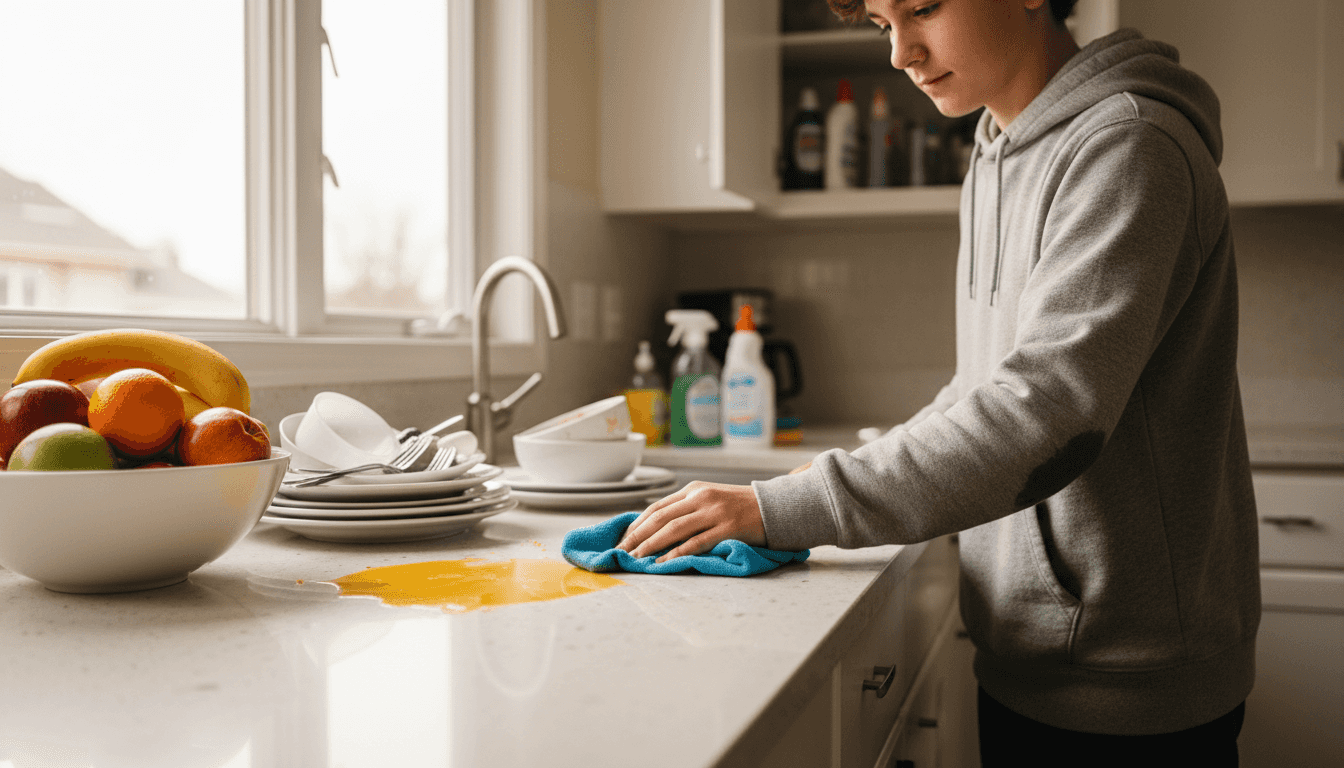
Microfiber cloths improve efficiency dramatically. They capture more dirt than cotton with less product needed, dry faster, and last through dozens of washes. Disposable cloths work for contaminated areas where reusable options create cross-contamination risks.
Matching methods to surfaces
Different surfaces require different approaches. Tile floors handle vigorous scrubbing; hardwood needs gentler treatment. Stainless steel requires specific products to avoid streaking. Granite demands pH-neutral cleaners to prevent etching.
The wrong method damages surfaces faster than dirt does. Abrasive scrubbing scratches finishes requiring expensive refinishing. Harsh chemicals discolor grout or eat through sealants.
The best cleaning solution matches your product, method, and surface to the actual contamination level in that space.
Pro tip: Start with detergent and a microfiber cloth for routine cleaning, add disinfection only for high-touch areas, and reserve deep cleaning methods for stubborn buildup—this approach saves time and prevents surface damage.
Here’s a comparison of common cleaning products and their suitability for household areas:
| Product Type | Best For | Relative Cost Per Use | Health/Environmental Factor |
|---|---|---|---|
| Commercial Detergent | Floors, counters, sinks | Moderate | May contain artificial fragrances |
| Disinfectants | High-touch surfaces, bathrooms | Higher | May cause irritation with overuse |
| Vinegar | Kitchen, glass, mopping | Low | Non-toxic, biodegradable |
| Baking Soda | Scrubbing stains, deodorizing | Very Low | Safe for kids and pets |
| Castile Soap | Multi-surface, gentle cleaning | Low | Plant-based, safe on most surfaces |
| Specialty Cleaners | Stubborn stains, mold, mildew | Highest | May contain harsh chemicals |
Eco-Friendly and DIY Cleaning Options
You don’t need expensive specialty products or harsh chemicals to keep your Massachusetts home clean. Simple household ingredients work just as well while costing far less and keeping your family safer.
Why DIY cleaning makes sense for busy households
Commercial cleaning products carry hidden costs beyond their purchase price. You’re paying for packaging, marketing, and chemicals that often sit unused. DIY solutions use ingredients you likely already own or can buy in bulk for pennies.
Busier schedules actually benefit from simpler systems. Fewer products mean fewer bottles to track, less storage space needed, and quicker decision-making about what to use where.
The three-ingredient solution
White vinegar, baking soda, and castile soap handle nearly every household cleaning task. White vinegar and hydrogen peroxide are effective kitchen sanitizers that cost a fraction of commercial disinfectants while being less toxic to your family.
These three ingredients work because of their chemistry:
- White vinegar: Dissolves mineral deposits, cuts grease, and kills many pathogens
- Baking soda: Provides gentle abrasion for scrubbing without scratching, neutralizes odors
- Castile soap: Cleans almost any surface safely, works in hard or soft water
Mix them differently for different jobs. Vinegar plus water becomes a spray cleaner. Baking soda plus water becomes a paste for tough spots. Castile soap plus water cleans floors.
Building your DIY cleaning toolkit
Start with basics you can buy at any Massachusetts grocery store. You don’t need a fully stocked cabinet of specialty products.
- White vinegar (one large bottle lasts months)
- Baking soda (buy in bulk)
- Castile soap liquid (one bottle makes gallons of cleaner)
- Microfiber cloths (reusable and effective)
- Old toothbrushes (perfect for detail work)
Benefits of using eco-friendly cleaning products extend beyond cost savings. You avoid breathing toxic fumes, reduce chemical exposure for children and pets, and stop contributing harmful substances to local water systems.
When to use professional help anyway
DIY cleaning works great for regular maintenance. Deep carpet cleaning, professional upholstery care, and post-construction debris removal often require specialized equipment and expertise that DIY approaches can’t match.
Busy households find the best balance: handle routine cleaning yourself with inexpensive ingredients, schedule professional deep cleaning seasonally or when needed, and focus your limited time on high-impact tasks.
Simple household ingredients clean effectively, cost dramatically less, and keep your family safer than most commercial products.
Pro tip: Keep a spray bottle of vinegar and water under your kitchen sink and use it for daily wipe-downs—this prevents buildup and means you’ll rarely need deep cleaning in that space.
Comparing Costs: Professional vs. DIY
The choice between professional cleaning and DIY comes down to more than just the upfront price tag. Your time, energy, and the actual results matter equally when calculating true cost.
The real cost of DIY cleaning
DIY cleaning seems cheaper because you only pay for products and supplies. A bottle of vinegar costs three dollars. A box of baking soda runs two dollars. Your initial investment looks tiny compared to hiring help.
But time has real value. If you spend five hours weekly cleaning, that’s 260 hours yearly. Busy Massachusetts professionals earning thirty dollars per hour lose nine thousand dollars in potential income or personal time they could spend with family.
Hidden DIY expenses add up
Products accumulate faster than expected. You buy specialty cleaners for specific jobs, tools that break, microfiber cloths that wear out, and replacements when you run out. DIY cleaning requires investment in products and tools, and lack of expertise may impair results or efficiency.
Consider these hidden costs:
- Product waste: Buying wrong products you never use
- Equipment damage: Harsh chemicals damaging surfaces requiring repairs
- Time inefficiency: Using wrong methods that require redoing work
- Health costs: Respiratory irritation or chemical exposure
- Opportunity cost: Hours not spent on income or family
What professional cleaning actually costs
Professional cleaning services involve investments in specialized equipment, trained personnel, and regulatory compliance, which contributes to operational costs while ensuring consistent, thorough results.
E.C. House Cleaning’s pricing reflects this reality. You’re paying for:
- Trained professionals who know how to clean efficiently
- Specialized equipment that works faster and better than consumer tools
- Eco-friendly products chosen specifically for your home
- Insurance and regulatory compliance
- Guaranteed quality and customer satisfaction
A two-bedroom apartment might cost one hundred fifty to two hundred fifty dollars for professional cleaning versus fifteen to twenty dollars in DIY supplies. But that professional service saves four to six hours of your time monthly.
The actual cost comparison
Calculate your real hourly value. If professional cleaning costs two hundred dollars and saves you six hours, that’s thirty-three dollars per hour. If your time is worth more, professional cleaning pays for itself.
Most busy households benefit from combining both approaches. Handle daily tidying yourself, schedule professional deep cleaning monthly or seasonally, and use that saved time on work, rest, or family activities.
The lowest price tag rarely equals the lowest true cost when you factor in time, quality, and your family’s wellbeing.
Pro tip: Schedule professional cleaning for deep jobs like carpet shampooing or move-in cleaning, then maintain results yourself between visits—this hybrid approach costs less than either extreme while keeping your home consistently clean.
This table summarizes key factors to help decide between professional and DIY cleaning approaches:
| Factor | DIY Cleaning | Professional Cleaning |
|---|---|---|
| Upfront Product Cost | Low | Included in service price |
| Time Required (per month) | 12-20 hours | 2-4 hours (prep/oversight only) |
| Result Consistency | Varies with experience | High, with satisfaction guarantee |
| Specialized Equipment | Usually unavailable | Provided by cleaning company |
| Hidden Costs | Product waste, repairs | Fewer, mainly scheduling |
Tips to Maximize Cleaning Value at Home
Maximizing your cleaning value means getting better results while spending less time and money. A few strategic changes to how you approach cleaning can cut your workload dramatically.
Start with decluttering
Clutter creates cleaning work. Every item on a surface needs to be moved, cleaned around, then moved back. Reducing clutter cuts cleaning time significantly while reducing dust accumulation throughout your home.
Busy households benefit most from simple rules. Each room gets designated storage zones. Items not used regularly move to closets or storage. Surfaces stay clear for quick daily wipes.
Use a systematic approach
Using a systematic cleaning checklist ensures thoroughness and efficiency by prioritizing tasks and focusing on high-touch surfaces. Instead of randomly cleaning, work room by room on a consistent schedule.
A simple routine beats sporadic deep cleaning:
- Daily: Tidy visible areas, wash dishes, wipe kitchen and bathroom counters
- Weekly: Vacuum, mop, dust surfaces, clean bathrooms thoroughly
- Monthly: Clean inside appliances, tackle one deep project, address problem areas
- Seasonally: Windows, baseboards, behind furniture, inside cabinets
This pattern prevents buildup that requires expensive remediation or professional intervention.
Focus on high-touch areas first
Your time is limited. Spend it where it matters most. Door handles, light switches, remote controls, and phone screens gather germs and oils. Clean these daily and your home feels cleaner overall.
Low-visibility areas like baseboards and inside cabinets can wait. No one sees them regularly, and they don’t affect your family’s health or comfort.
Prevention prevents expensive problems
Decluttering, pest-proofing, fixing leaks, and choosing low-VOC products like baking soda and vinegar maximize your home’s cleanliness while avoiding expensive repairs and health issues.
Simple prevention saves thousands:
- Fix leaks immediately: Prevents mold requiring costly remediation
- Pest-proof your home: Prevents infestations needing professional treatment
- Control humidity: Stops mold growth before it spreads
- Use quality vacuum filters: HEPA filters catch allergens, improving health
- Clean regularly: Prevents buildup that damages surfaces
Choose products strategically
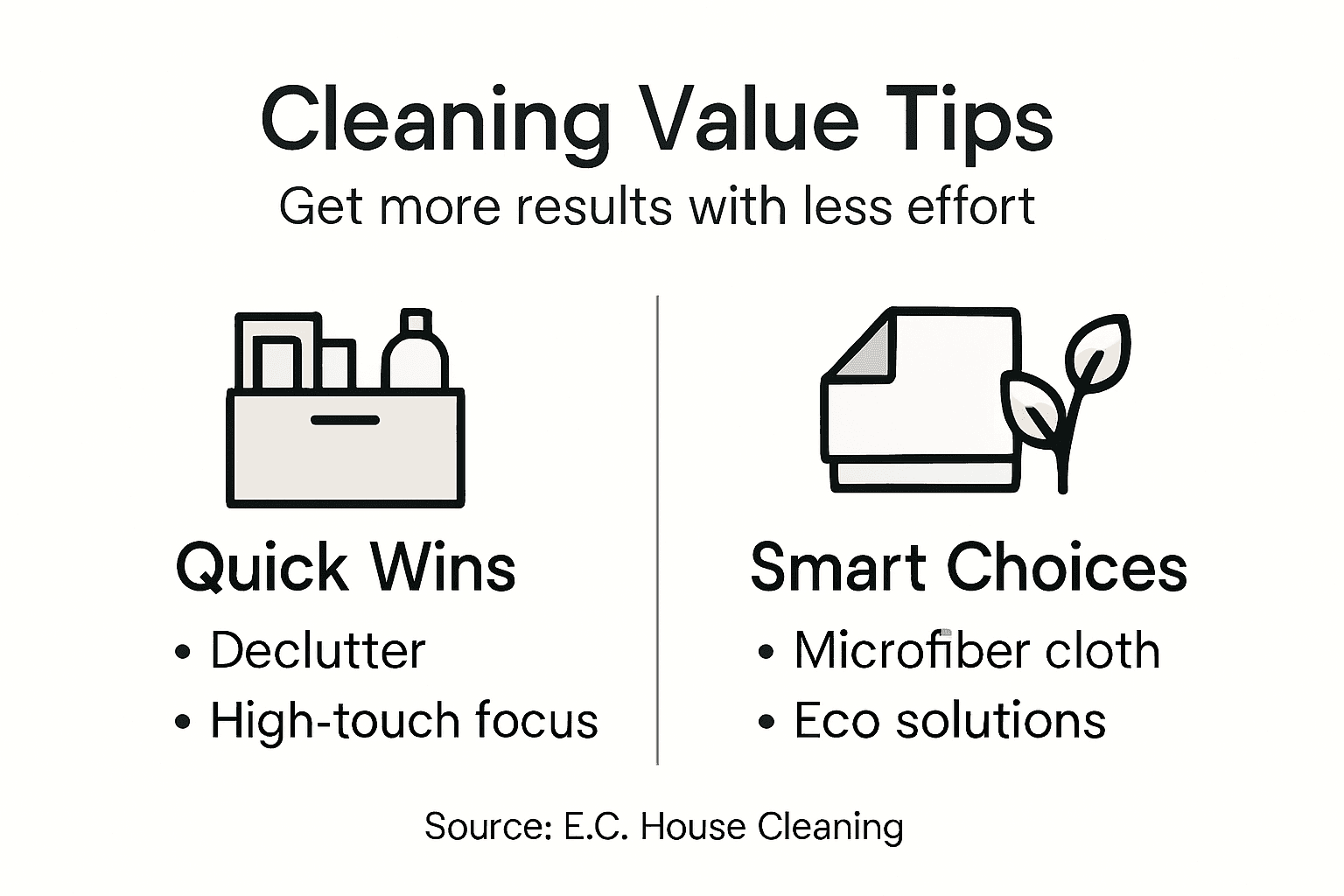
You don’t need separate products for every surface. Professional cleaning tips show that quality basics—vinegar, baking soda, castile soap—handle most household jobs effectively while costing less and keeping your family safer.
Expensive specialty products create unnecessary expense. Stick with what works, what’s safe, and what’s affordable.
Preventing problems through consistent maintenance costs far less than fixing damage or hiring specialists later.
Pro tip: Create a simple checklist of your five most-used areas and clean them daily—this prevents 80 percent of cleaning problems while taking only 15 minutes daily.
Achieve Cost-Effective Cleaning Without Sacrificing Your Time or Quality
Busy households face the challenge of maintaining a clean and healthy home while managing tight schedules and budgets. This article highlights the importance of choosing cleaning solutions that deliver value for every dollar and every minute you spend. Avoid wasting time on ineffective products or over-cleaning low-risk areas. Instead, focus on smart, eco-friendly methods paired with strategic professional support to keep your home spotless and safe.
Discover practical tips and homemade options in Dollar Tree Homemade Cleaning Solutions | E.C. House Cleaning and explore more ways to save with Affordable Cleaning Tips In Massachusetts | E.C. House Cleaning.
Let E.C. House Cleaning bring professional expertise and eco-friendly practices right to your Massachusetts home. With over 20 years of family-owned experience, trusted service, and flexible options like deep cleaning and move-in/move-out cleaning, we help busy homeowners save valuable time while maintaining a healthy living environment. Visit our site now to schedule your free consultation and experience quality cleaning tailored to your needs.
Frequently Asked Questions
What are some cost-effective cleaning solutions for busy households?
Cost-effective cleaning solutions include using household items like white vinegar, baking soda, and castile soap, which are cheaper per use than specialized products while being effective and safe for your family.
How can I determine which cleaning method to use for different surfaces?
Match the cleaning method to the contamination risk. For example, use a detergent for routine dirt on surfaces, disinfectants for high-touch areas, and specialty cleaners for stubborn stains or buildup.
What is the difference between detergent-based cleaners, disinfectants, and specialty cleaners?
Detergent-based cleaners remove dirt and oils, disinfectants kill germs on high-touch surfaces, and specialty cleaners tackle specific issues like mold or hard water stains, each serving different cleaning needs.
How can I maintain a clean home without spending too much time?
Implement a systematic cleaning approach by decluttering, focusing on high-touch areas first, and maintaining a consistent cleaning schedule that prevents buildup and reduces overall cleaning time.