TL;DR:
- Trust in cleaning services depends on verifiable signals, consistent staffing, and honest communication.
- Building long-term confidence requires transparent practices, clear pricing, and reliable staff.
Trust in cleaning services is defined as a client’s confidence that a provider will perform reliably, safely, and honestly every single visit. Without that confidence, clients cancel contracts, leave negative reviews, and never return. Research confirms that professionalism and transparency are the top drivers of client decisions in the cleaning industry. The role of trust in cleaning goes far beyond a spotless floor. It shapes every interaction from the first booking call to the hundredth recurring visit, and it directly determines whether a cleaning relationship lasts months or years.
What are the primary trust factors in cleaning services?
Clients evaluate trust before they ever let a cleaner through the door. The decision to hire is based on visible signals, not gut feeling alone. Background checks, insurance, and certifications are the three most auditable trust signals a cleaning company can display.

The numbers make the stakes clear. 81% of homeowners refuse to hire a cleaning service that does not perform background checks on its staff. Yet fewer than 30% of cleaning company websites mention background checks at all. That gap represents a massive missed opportunity for any provider serious about converting new clients.
Pricing clarity matters just as much as staff vetting. An Oricon survey of 5,211 clients in 2026 ranked ease of use and cost performance as the highest trust-related factors in cleaning service satisfaction. Clients who cannot quickly understand what they will pay, or how to book, lose confidence before the first appointment is set.
Here are the core trust signals clients look for when hiring:
- Background checks and insurance: Verifiable staff vetting removes the biggest fear of letting a stranger into a home or office.
- Clear pricing: Transparent quotes with no hidden fees signal honesty from the first interaction.
- Easy booking: A frictionless scheduling process communicates that the company respects the client’s time.
- Certifications and training records: Documented training shows that quality is a system, not a guess.
- Online reviews and testimonials: Third-party validation from real clients carries more weight than any marketing claim.
Pro Tip: Ask any cleaning company directly whether their staff passes a multi-step background check that includes criminal history and reference verification. A company that cannot answer that question clearly has not made vetting a priority.
Cleaning companies that display trust credentials on their website convert at 22–30% higher rates and can charge 15–25% more per visit. That data shows trust is not just a soft value. It is a measurable business advantage.
How does staffing consistency build long-term client confidence?
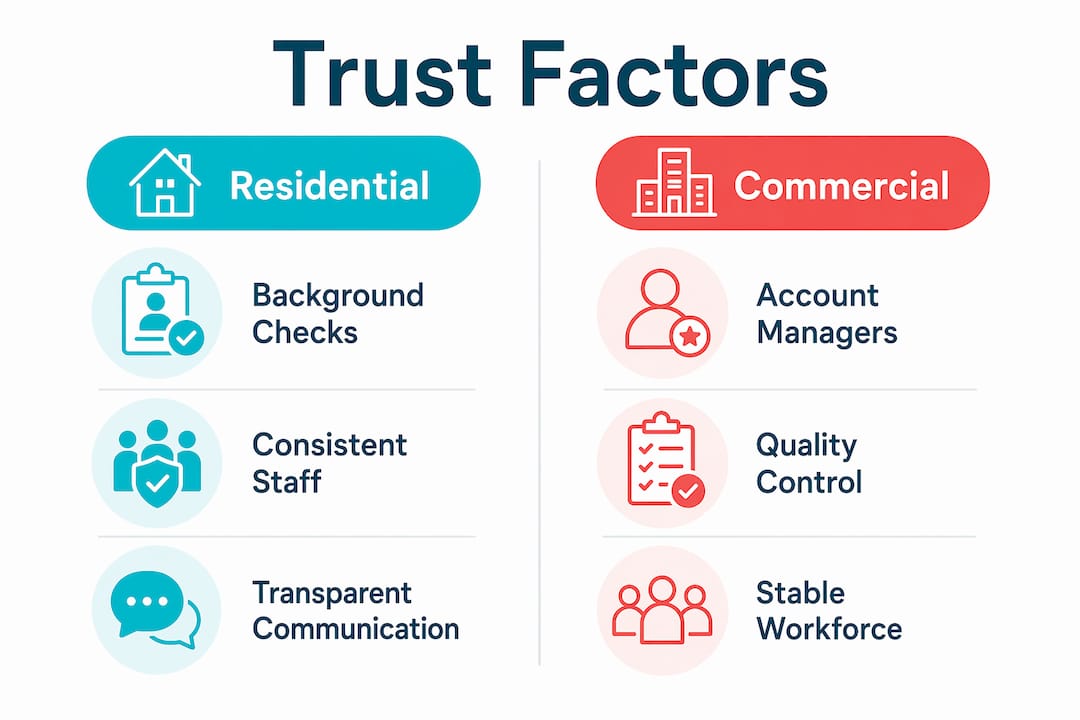
Consistency is the operational expression of trust. A client who sees the same cleaner every two weeks builds a working relationship with that person. When that cleaner changes without notice, the trust does not automatically transfer to the replacement.
Trust continuity does not carry over between cleaning personnel. A client who trusts one cleaner deeply may feel uncomfortable with a new face, even if that new cleaner is equally skilled. Residential clients in particular report that familiarity with their cleaner is a key reason they stay with a service long term. Assigning the same cleaner to the same client is not just a scheduling preference. It is a trust management decision.
For commercial clients, the trust dynamic shifts slightly but the principle holds. Consistent client-facing standards and site-specific protocols prevent clients from feeling they are dealing with a different vendor at every visit. A commercial property manager who sees rotating crews with no standardized checklist quickly loses confidence in the provider’s quality control.
| Trust Factor | Residential Impact | Commercial Impact |
|---|---|---|
| Same cleaner assigned | High: builds personal comfort | Medium: less personal, but still valued |
| Documented protocols | Medium: reassures on quality | High: required for compliance and consistency |
| Staff turnover rate | High: disrupts familiarity | High: signals operational instability |
| Quality control checks | Medium: confirms standards | High: essential for contract renewal |
Long-term client trust is earned through consistent staffing, clear specifications, and ongoing quality control rather than one-off deep cleans. A single impressive clean does not build a relationship. Repeated, predictable performance does.
Pro Tip: If you manage a commercial cleaning contract, request a named account manager and a written quality control schedule. Both reduce the risk of service drift over time.
Workforce stability also signals internal health. High staff turnover tells clients that a cleaning company struggles to retain good people. That instability creates uncertainty about who will show up and whether they will meet the same standard as the last team. Workforce stability and structured quality control are the two operational levers that reduce client uncertainty most effectively.
Why does transparency matter more than cleaning quality alone?
A perfectly cleaned office means nothing if the client never hears from the provider when something goes wrong. Trust always comes back to honesty and transparency, and a lack of direct communication erodes trust even when the physical cleaning quality is high. ISS, one of the world’s largest facility services companies, identifies this as the single most underestimated trust factor in the industry.
The invisible nature of cleaning work makes trust especially dependent on process signals. Clients cannot watch every clean happen. What they can observe is whether the provider communicates proactively, admits mistakes, and follows through on commitments. Those behaviors become the proxy for quality when the work itself is unseen.
Transparency in practice looks like this:
- Sharing cleaning protocols: Clients who know exactly what products are used and why feel more confident in the service.
- Proactive updates: Notifying a client about a delayed arrival before they notice it builds far more goodwill than apologizing after.
- Honest problem reporting: If a cleaner breaks something or misses a task, reporting it immediately preserves trust. Hiding it destroys it.
- Clear contracts: Spelling out scope, frequency, and pricing in writing removes ambiguity that breeds suspicion.
“Trust always comes back to honesty and transparency. Lack of direct communication erodes trust even if cleaning quality is high.” — ISS Facility Services
Reducing unpredictability like lateness without communication is as critical as the clean itself. A cleaner who arrives 30 minutes late without a message signals disrespect for the client’s schedule. That single friction point can undo weeks of good work. Day-to-day operational reliability, especially timely communication, is as critical as cleaning quality for sustaining client trust over time.
How to verify and build trust when choosing a cleaning service
Choosing a trustworthy cleaning provider requires a structured approach, not just a Google search and a price comparison. The questions you ask before hiring a cleaner reveal more about a company’s trustworthiness than any website claim.
Follow these steps to assess and build trust with a cleaning provider:
- Confirm background check procedures. Ask whether every employee passes a criminal background check and reference verification before their first assignment.
- Verify insurance coverage. A legitimate cleaning company carries general liability insurance. Request proof before signing any contract.
- Check for certifications. Industry certifications from organizations like ISSA (the Worldwide Cleaning Industry Association) indicate structured training and professional standards.
- Read verified reviews. Look for patterns in Google, Yelp, or HomeAdvisor reviews. Consistent praise for reliability and communication is a stronger signal than a single five-star rating.
- Request a named cleaner. For residential clients especially, ask whether the same person will be assigned to your home on each visit.
- Establish a feedback loop. Agree upfront on how issues will be reported and resolved. A provider with no clear complaint process is a risk.
- Review the contract carefully. Confirm that scope, frequency, pricing, and cancellation terms are written clearly before committing.
Hiring reliable cleaning services in Massachusetts involves checking all of the above, but the single most predictive factor is whether the company assigns consistent personnel and maintains a documented quality control process.
Pro Tip: Request a trial clean before committing to a long-term contract. One visit tells you more about reliability, communication, and attention to detail than any sales conversation.
93% of customers are likely to make repeat purchases when a company delivers excellent customer experience. That statistic applies directly to cleaning services. Clients who feel respected, informed, and consistently served do not look for alternatives.
A multi-step hiring process that includes interviews, background checks, supervised training, and a client feedback period produces more trustworthy cleaners than a simple background check alone. The depth of the vetting process is a direct signal of how seriously a company takes client safety and satisfaction.
Key Takeaways
Trust in cleaning services is built through verifiable signals, consistent staffing, and honest communication, not cleaning quality alone.
| Point | Details |
|---|---|
| Background checks are non-negotiable | 81% of homeowners refuse to hire without them, yet fewer than 30% of providers advertise this. |
| Staffing consistency drives loyalty | Assigning the same cleaner to the same client preserves trust that does not transfer automatically. |
| Transparency prevents trust erosion | Proactive communication about delays, mistakes, and protocols protects the relationship long term. |
| Pricing clarity builds confidence early | Clients who understand costs upfront are more likely to book and return. |
| Quality control systems signal professionalism | Documented protocols and feedback loops show that standards are managed, not assumed. |
What I’ve learned about trust that most cleaning articles miss
After years of working in and around the cleaning industry in Massachusetts, the pattern I see most often is this: companies lose clients not because the cleaning was bad, but because communication broke down. A missed call about a rescheduled visit. A broken item that was never mentioned. A new cleaner sent without any introduction. Each of these feels small in isolation. Together, they signal that the client is not a priority.
The trust that top qualities in good cleaners create is not just about technique. It is about the cleaner’s behavior when something goes wrong. Anyone can clean well on a good day. The real test is what happens when a team member calls out sick, a product runs out, or a client raises a complaint. How a company handles those moments tells you everything about whether trust is a value or just a marketing line.
Scaling a cleaning operation is where trust gets genuinely difficult. Adding new staff, new clients, and new locations introduces variability that erodes the consistency clients depend on. The companies that manage this well invest in standardized onboarding, written protocols, and regular client check-ins. They treat trust as an operational system, not a personality trait.
My honest recommendation: before you sign any cleaning contract, ask the company what happens when your regular cleaner is unavailable. The answer will tell you whether they have thought seriously about trust continuity or whether they are improvising.
Trusted cleaning in Massachusetts starts with EC House Cleaning
EC House Cleaning brings over 20 years of family-owned experience to residential and commercial cleaning across Massachusetts. Every team member passes a thorough background check, and the same cleaner is assigned to your home or office to preserve the consistency that builds real confidence over time.
Whether you need residential cleaning services for your home or cleaning services for small businesses, EC House Cleaning operates with full insurance, transparent pricing, and a clear quality control process. Clients across Massachusetts trust EC House Cleaning because the company treats reliability and honesty as operating standards, not selling points. Request a free quote today and see what a genuinely trustworthy cleaning service looks like in practice.
FAQ
Why does trust matter so much in hiring cleaners?
Trust matters because cleaners work inside private homes and offices, often without direct supervision. Clients need confidence that staff are vetted, reliable, and honest before granting that level of access.
What are the strongest trust signals a cleaning company can show?
Background checks, proof of insurance, certifications, and verified client reviews are the four most credible trust signals. Companies that display these credentials convert at significantly higher rates and can charge more per visit.
Does it matter if the same cleaner comes every time?
Yes. Trust does not transfer automatically between cleaning personnel. Assigning the same cleaner to the same client is one of the most effective ways to maintain long-term client confidence.
How does communication affect trust in cleaning services?
Poor communication erodes trust even when cleaning quality is high. Proactive updates about delays, honest reporting of problems, and clear contracts are the communication practices that protect client relationships over time.
How can businesses evaluate a cleaning provider’s trustworthiness?
Businesses should request documented quality control processes, ask about staff turnover rates, and confirm that site-specific protocols are in place before signing a commercial cleaning contract.