
TL;DR:
- Detail-oriented cleaning involves consistently addressing hidden areas like grout lines, baseboards, and appliance edges that standard routines often miss.
- By focusing on high-priority rooms such as kitchens and bathrooms, it prevents damage, reduces repair costs, and promotes healthier environments.
Most people believe a clean home means wiped counters and a vacuumed floor. That’s not wrong. It’s just incomplete. What is detail-oriented cleaning? It’s the practice of going beyond visible surfaces to address the grout lines, the cabinet edges, the faucet handles, and every spot that routine cleaning skips. Detail-oriented cleaning requires consistent effort and a trained eye, and it produces results that standard cleaning simply cannot match. This guide breaks down exactly what it means, where it matters most, and how you can build it into your routine.
Table of Contents
- Key takeaways
- What is detail-oriented cleaning, really?
- Overlooked areas that define detail cleaning
- Benefits of adopting detail-oriented cleaning practices
- How to build detail cleaning into your routine
- Misconceptions and real barriers to overcome
- My take on what detail cleaning actually changes
- How Echousecleaning brings detail-oriented cleaning to your home
- FAQ
Key takeaways
| Point | Details |
|---|---|
| Beyond surface cleaning | Detail-oriented cleaning targets hidden and overlooked areas that standard routines consistently miss. |
| Kitchens and bathrooms first | These rooms accumulate the most buildup and bacteria, making them the highest priority for detailed attention. |
| Prevents costly repairs | Regular meticulous cleaning protects surfaces and fixtures, reducing long-term maintenance expenses. |
| Frequency beats intensity | Short, frequent cleaning sessions maintain tidiness better than occasional deep cleans. |
| Right tools make the difference | Using products matched to specific surfaces separates cleaning that works from cleaning that just moves dirt around. |
What is detail-oriented cleaning, really?
Detail-oriented cleaning is the practice of giving careful, deliberate attention to every part of a space, including the parts you cannot see at a glance. It is not a single event. It is a consistent habit that involves assessing each room individually rather than running through the same surface-level checklist every week.
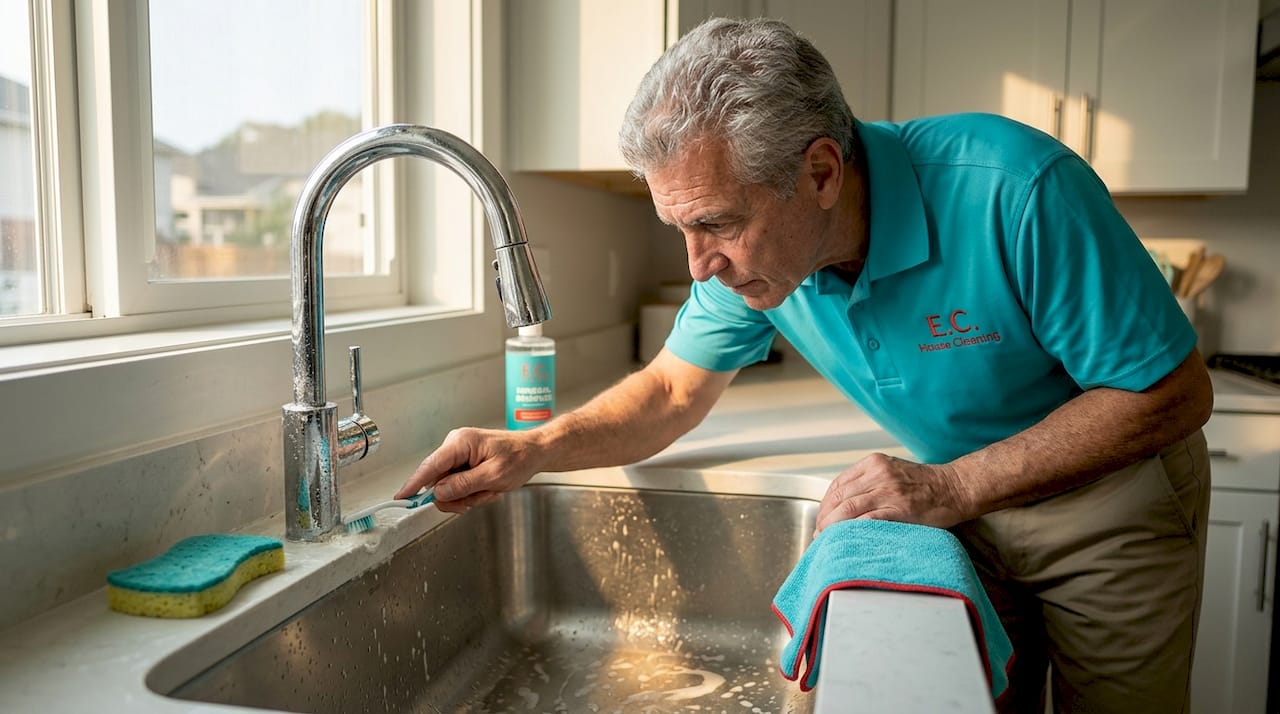
Think about your kitchen. A standard clean wipes the countertop, rinses the sink, and maybe mops the floor. A detail-oriented clean does all of that, then addresses the grout between the tiles, the residue along the edge of the stovetop, the grime on the light switch plate, and the buildup under the refrigerator. The difference is not just visual. It’s the difference between a space that looks clean and one that actually is clean.
What separates this approach from what most people practice comes down to three things:
- Scope. Detail cleaning covers areas like grout lines, baseboards, sink fixtures, and appliance edges that standard routines ignore entirely.
- Intention. Every cleaning session starts with a visual inspection, not just a habit loop. You look for buildup, discoloration, and residue before deciding where to focus.
- Consistency. Detail cleaning is not a once-a-year deep clean. It is a regular part of your maintenance rhythm, catching problems before they become permanent.
Pro Tip: Before you start any cleaning session, spend 60 seconds scanning the room from a low angle. Light reveals buildup on surfaces that looks invisible from standing height. You will spot grease splatter, dust on baseboards, and water stains that you would otherwise miss entirely.
Overlooked areas that define detail cleaning
Kitchens and bathrooms require more detailed cleaning attention than any other part of a home or workplace. They experience constant moisture, grease, and heavy use, which means buildup happens fast and compounds quickly when ignored.
Mineral-heavy water leaves residue around faucets, showerheads, and sinks, and those deposits become significantly harder to remove the longer they sit. Grout lines in tiled showers and kitchen backsplashes absorb bacteria and discolor in ways that simple wiping cannot resolve. Exhaust vents collect grease and dust that reduce airflow and become fire hazards over time. These are not edge cases. They are exactly the spots where detail-focused cleaning earns its value.
| Area | Standard cleaning task | Detail cleaning task |
|---|---|---|
| Kitchen counters | Wipe visible surfaces | Clean under appliances, degrease backsplash tile grout |
| Bathroom sink | Rinse basin | Descale faucet base, clean drain stopper and overflow plate |
| Shower/tub | Spray and rinse walls | Scrub grout lines, clean track channels, remove hard water deposits |
| Kitchen stovetop | Wipe burner covers | Clean beneath burner grates, degrease control knobs and surrounding edges |
| Exhaust vents | Ignored | Remove vent cover, wipe blades, clear grease-coated mesh |
| Light switches and handles | Ignored | Disinfect plates, wipe handles with appropriate cleaner |
| Baseboards | Ignored | Dust, then wipe with damp cloth to remove embedded grime |
The table above shows how even rooms you think you clean regularly can harbor significant buildup in their overlooked corners. Detail cleaning does not mean spending three hours in the bathroom. It means knowing which specific spots to hit and hitting them consistently.
Benefits of adopting detail-oriented cleaning practices
The most immediate benefit is a healthier space. Bacteria and allergens accumulate in exactly the places that standard cleaning skips: grout, handles, vents, and fabric edges. Addressing these areas consistently lowers the microbial load in your home or office and reduces airborne particles that trigger allergies and respiratory irritation.
The longer-term benefit is financial. Routine cleaning protects surfaces and keeps a home in good condition, directly supporting property value and reducing the need for costly repairs or replacements. Grout that is never cleaned eventually requires regrouting. Faucets corroded by mineral deposits need replacing. Finishes degraded by accumulated grime cannot be restored without professional refinishing. Detail-oriented cleaning, when practiced consistently, prevents all of that.
“Detail-oriented cleaning acts as preventive maintenance, preserving materials and reducing repair costs over the long term.” — Why Routine Cleaning Protects Home Surfaces and Supports Long-Term Property Value
There is also a measurable mental health benefit. Research consistently connects clean, organized environments to lower stress and improved focus. A workspace where every surface, handle, and corner is genuinely clean feels different from one that only looks presentable from across the room. That difference is real and worth building into your routine. For more on how detailed cleaning supports health and lowers long-term costs, the connection between meticulous habits and property care is well documented.
How to build detail cleaning into your routine
The biggest barrier to cleaning with precision is not time. It is the lack of a system. Without one, cleaning feels like a vague, endless task. With one, it becomes a set of clear, manageable actions that fit naturally into your week.
Here is a practical framework for getting started:
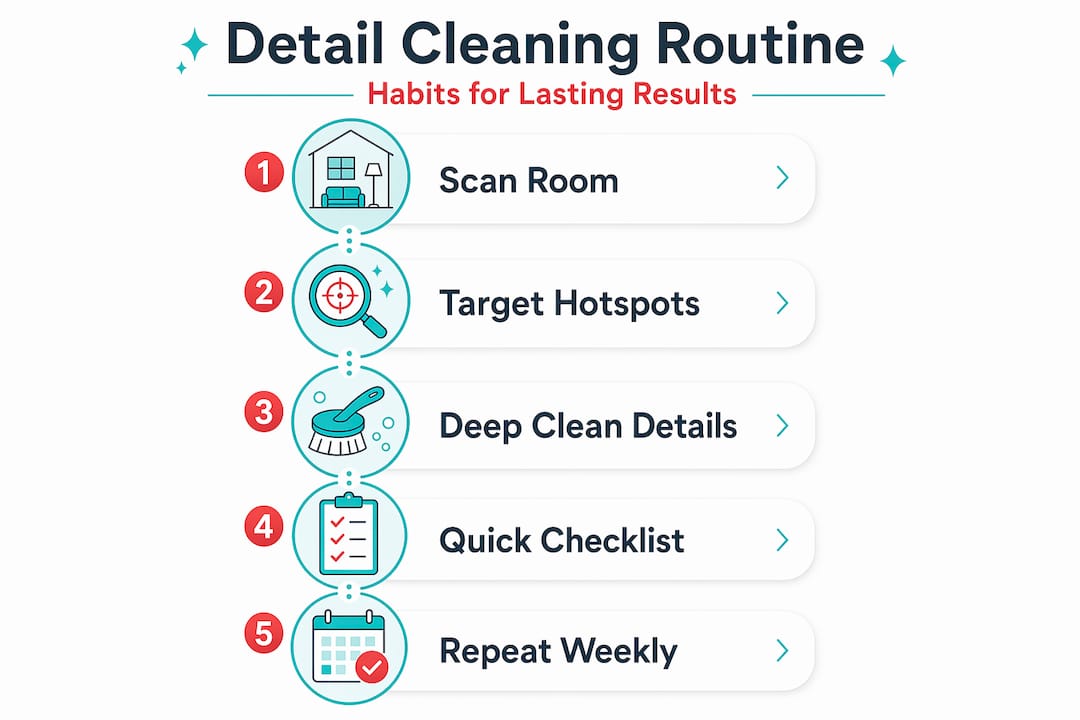
- Audit your space first. Walk every room and list the spots that never get cleaned. Baseboards, light switches, vent covers, behind the toilet, under the stove. Write them down. You need a real inventory before you can build a realistic routine.
- Break tasks by frequency. Some detail tasks belong in your weekly routine, like wiping handles and faucet bases. Others belong in a monthly checklist, like cleaning exhaust vents and grout. Separating them prevents overload and makes each session manageable.
- Assign the right tools. Using the right cleaning products is what separates cleaning that actually works from cleaning that moves the problem around. A multi-surface spray handles most surfaces. A dedicated degreaser belongs in the kitchen. A descaling product handles mineral deposits in bathrooms. Matching tools to tasks is not optional. It is the foundation of effective detail work.
- Clean little and often. Tidy homes are cleaned more frequently, for shorter periods, which prevents the buildup that requires intensive intervention. A ten-minute detail pass twice a week beats a two-hour overhaul once a month, every time.
- Use logical storage. Every item should have a designated place it reliably returns to. The best systems make the right behavior the path of least resistance. When your cleaning tools are stored where you use them, you will actually use them.
- Check your work. End every session by doing the low-angle scan mentioned earlier. Catching a spot you missed takes ten seconds now. Removing months of buildup from the same spot takes considerably longer.
Pro Tip: Keep a small checklist on your phone or posted inside a cabinet door. It does not need to be elaborate. Just a list of the detail tasks that belong in each room, organized by frequency. Professional cleaners use checklists not because they forget, but because the checklist removes the mental work of deciding what to do next. For structured weekly plans you can adapt immediately, the weekly cleaning step-by-step guide from Echousecleaning is a solid starting point.
Misconceptions and real barriers to overcome
The most common reason people avoid detail-focused cleaning is the belief that it is too time-consuming. That belief usually comes from conflating detail cleaning with deep cleaning. A full deep clean is intensive. Detail cleaning, practiced regularly, is not. The whole point is to prevent the deep clean from ever being necessary.
A few other misconceptions worth addressing:
- “I will know when something needs cleaning.” You will not. Grout discolors gradually. Hard water deposits build over months. Bacteria is invisible. The areas that most need attention are often the ones that show no visible warning signs until the damage is done.
- “Cleaning products are all the same.” They are not. Using a general-purpose spray on mineral deposits achieves nothing. Using a kitchen degreaser on bathroom tile grout is ineffective. The wrong product wastes your time and leaves the problem in place.
- “My space does not need that level of attention.” Every space does. The difference between homes that age well and homes that deteriorate comes down almost entirely to maintenance habits, and detail cleaning is the core of those habits.
The mindset shift that matters most is moving from crisis cleaning to maintenance cleaning. Crisis cleaning happens when you notice a problem. Maintenance cleaning happens on a schedule. One of those approaches protects your space. The other reacts to damage after it has already occurred. The tips from professional cleaners at Echousecleaning consistently point to this shift as the single biggest change that improves long-term cleanliness.
My take on what detail cleaning actually changes
I have seen a lot of spaces that look clean and are not. The difference is always the same. The surface got attention. The edges did not.
What I have found is that the people who maintain genuinely clean homes and offices are not spending more time cleaning than everyone else. They are spending their time differently. Short sessions. Specific targets. The right tools for each job. They do not wait until the bathroom grout is visibly black to address it. They wipe it down every week, and it never gets to that point.
The conventional approach, where you clean when things look dirty, is almost always counterproductive. By the time something looks dirty, the buildup has been there long enough to cause real damage. Grout that has been left for six months requires scrubbing, a commercial cleaner, and sometimes professional treatment. Grout that gets wiped weekly requires about thirty seconds.
What I have learned from paying attention to this is that detail cleaning is not about perfectionism. It is about practicality. Small, consistent effort beats large, infrequent effort every single time. The spaces that feel truly clean, the ones where you notice the air quality and the way surfaces look in natural light, are maintained that way. Not transformed occasionally.
If you are thinking about where to start, start with your kitchen and bathroom. Work the grout, the fixtures, and the edges. Do it consistently for a month. The difference will speak for itself.
— Andrew
How Echousecleaning brings detail-oriented cleaning to your home
If building and maintaining a detail-focused cleaning routine on your own feels like more than you have bandwidth for right now, that is exactly the problem Echousecleaning was built to solve.

With over 20 years of experience serving residential and commercial clients across Massachusetts, the Echousecleaning team applies the same meticulous, precision-focused approach described throughout this article to every job. From kitchens and bathrooms to baseboards and vent covers, nothing gets skipped. Whether you need recurring maintenance cleaning or a one-time residential cleaning service in Massachusetts, you can get a personalized quote online and schedule at your convenience. For homeowners who want to understand exactly what professional care involves, the breakdown of what a residential cleaner does makes the scope of the work clear. Echousecleaning is insured, family-owned, and backed by a track record of consistent, thorough results.
FAQ
What is the meaning of detail-oriented cleaning?
Detail-oriented cleaning means deliberately addressing the small, hidden, and frequently overlooked areas of a space that standard routines miss, such as grout lines, baseboards, faucet bases, and appliance edges. It requires consistent effort and a trained eye rather than a one-time intensive effort.
How is detail cleaning different from regular cleaning?
Regular cleaning addresses visible messes on primary surfaces. Detail cleaning goes further to treat buildup in areas like exhaust vents, shower tracks, cabinet edges, and light switches that accumulate bacteria and residue over time.
Why do kitchens and bathrooms need the most attention?
Kitchens and bathrooms experience constant moisture, grease, and heavy use, making them the fastest to accumulate hard water deposits, bacteria, and grime in porous surfaces like grout. Consistent detail cleaning in these rooms prevents long-term surface damage.
How often should detail cleaning tasks be done?
High-touch surfaces like handles and faucet bases benefit from weekly attention. Tasks like cleaning exhaust vents, grout, and behind appliances fit naturally into a monthly schedule. Frequent, short sessions prevent the kind of buildup that requires intensive removal.
Can detail cleaning actually protect property value?
Yes. Routine cleaning protects surfaces and supports long-term property value by preventing the material degradation that leads to costly repairs and replacements of fixtures, tiles, and finishes.