TL;DR:
- Effective property management cleaning requires understanding specific service types and schedules for tenants and common areas.
- Reliability and eco-friendliness are essential, with checks on insurance, staff vetting, and sustainable practices.
- Building strong, ongoing relationships with cleaning providers ensures consistent, high-quality results and protects against disputes.
Managing properties in Massachusetts means juggling tenant expectations, tight turnover windows, and a growing list of compliance concerns. Too many property managers hand cleaning contracts to the lowest bidder, only to deal with inconsistent results, missed scope items, and frustrated tenants. The right cleaning service is not just a vendor. It is a direct line to property value, tenant retention, and operational peace of mind. This guide breaks down how to find, evaluate, and manage eco-friendly, reliable cleaning services built specifically for Massachusetts residential and commercial portfolios.
Table of Contents
- Understanding cleaning services for property management
- Types of cleaning services for properties: Which do you need?
- What makes a cleaning service reliable and eco-friendly?
- How to hire and manage a cleaning service for your properties
- What most managers miss about cleaning services
- Next steps: Connect with trusted Massachusetts cleaning services
- Frequently asked questions
Key Takeaways
| Point | Details |
|---|---|
| Tailor cleaning by property type | Different properties require different cleaning schedules and scopes to maximize value and tenant satisfaction. |
| Eco-friendly is a must | Choosing green cleaning protects health, the environment, and meets local eco expectations in Massachusetts. |
| Reliability matters most | Consistent, fully-vetted cleaning support wins long-term tenants and reduces manager workload. |
| Communication prevents problems | Ongoing check-ins, clear contracts, and feedback loops with providers avoid costly misunderstandings. |
Understanding cleaning services for property management
Property management cleaning is not the same as hiring someone to tidy up a home once a month. The stakes are different. Your clients, your tenants, and your properties all depend on a consistent standard that protects value and keeps units rentable.
Rental cleaning service benefits for Massachusetts hosts and managers go well beyond a clean surface. These services must cater to tenant turnovers, value retention, and compliance with local housing codes. That is a very different mandate than a standard home cleaning appointment.
Here is what property management cleaning typically covers:
- Routine maintenance cleaning for occupied residential units and commercial spaces
- Turnover cleaning between tenants, covering every surface from floor to ceiling
- Move-in and move-out cleaning with documentation and checklists
- Deep cleaning for long-term tenant departures or units that have been vacant
- Common area cleaning in multi-unit residential buildings, office parks, and mixed-use properties
- Post-construction or post-renovation cleaning after repair work or major upgrades
Each of these has its own scope, frequency, and quality benchmark. Treating them interchangeably is a common mistake that results in unhappy tenants, security deposit disputes, and properties that take longer to lease.
Massachusetts adds its own layer of complexity. Harsh winters mean more salt, sand, and moisture tracked into units. Spring and fall create heavy tenant turnover cycles in college towns like Boston, Worcester, and Amherst. There is also a growing regulatory and market push toward sustainability. Tenants and owners increasingly ask about the products used and whether they are safe for families, pets, and the environment.
“A cleaning service that does not understand property management cycles is not the right partner for your portfolio, no matter how low the quote.”
The stakeholders involved make this even more critical. You are answering to property owners who want clean books and maintained assets. You are serving tenants who expect livable, fresh spaces. And you are managing your own reputation as the professional who keeps it all running smoothly. Your cleaning partner needs to understand that full picture.
Types of cleaning services for properties: Which do you need?
Not every property in your portfolio needs the same type of cleaning. Getting this wrong means overpaying for some units and under-servicing others.
Here is a breakdown of the most common service types and when to use them:
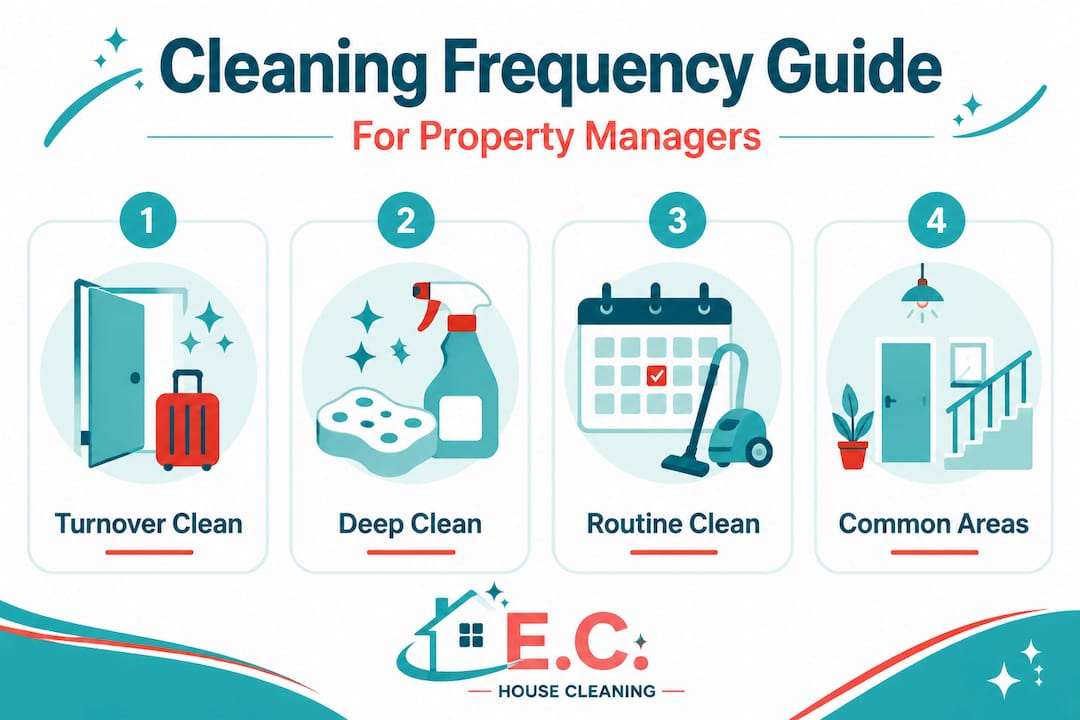
Residential turnover cleaning: Scheduled between tenancies. Every room, every surface, including inside appliances, cabinets, and closets. This is your most critical service type because it directly affects how fast a unit rents and whether you return a security deposit with confidence.
Commercial routine cleaning: Office spaces, retail units, and mixed-use properties need scheduled cleaning that fits around business hours. Think restrooms, common areas, floors, and trash.
Common area and hallway cleaning: In multi-family buildings, shared spaces often get overlooked. Lobbies, stairwells, laundry rooms, and mailrooms need their own schedule and scope.
Move-in and move-out cleaning: These go deeper than routine service. Cleaning rental properties for flawless turnovers means scrubbing grout, degreasing kitchens, sanitizing bathrooms, and wiping baseboards. Move-in and move-out cleaning is critical for tenant turnover and value preservation, which is why these cleans require dedicated checklists and thorough documentation.
Deep cleaning: For units that have not been professionally cleaned in over a year, or after long-term tenants vacate. Deep cleaning solutions specifically support property management needs by resetting a unit to a rentable baseline, which protects both owner investment and future tenant satisfaction.
Airbnb and short-term rental cleaning: Faster turnarounds, linen changes, restocking consumables, and guest-ready presentation. This is a specialty service that not every provider can handle well.
Post-renovation cleaning: After repairs or upgrades, construction dust and debris need professional removal. This is not a job for your maintenance team.
| Service type | Frequency | Best for |
|---|---|---|
| Routine maintenance | Weekly or biweekly | Occupied units, offices |
| Turnover cleaning | Between tenants | Residential rentals |
| Deep cleaning | Annually or at move-out | Long-term tenants, neglected units |
| Common area | Weekly or as needed | Multi-family, mixed-use |
| Airbnb turnover | After every guest stay | Short-term rentals |
| Post-renovation | Project completion | After major repairs or upgrades |
Pro Tip: Schedule routine maintenance cleaning every four to six weeks even for occupied units. This prevents the buildup that turns a simple turnover into a costly deep clean requiring multiple crews and extra time.
What makes a cleaning service reliable and eco-friendly?
Reliability and eco-friendliness are not just marketing words. They are operational requirements for property managers who need things done right the first time, every time.
Here is a checklist of what to look for before signing with any cleaning provider:
- Liability insurance and bonding: Protects you if something is damaged or goes wrong in a unit. Non-negotiable.
- Background-checked staff: Every cleaner should be vetted. You are giving access to occupied or vacant properties.
- Clear written service agreements: Vague scopes lead to disputes. Get everything in writing, including exactly what each service type covers.
- Transparent pricing: Avoid providers who quote low and add fees after the fact.
- Consistent crews: Rotating unknown staff through your properties creates risk and inconsistency.
- Responsive communication: Your cleaning partner should confirm appointments, flag issues, and respond to messages promptly.
On the eco-friendly side, eco-friendly cleaning insights show that sustainable products and methods are increasingly preferred by Massachusetts businesses and property managers. Eco-friendly products and methods protect tenant health, reduce liability around chemical exposure, and align with Massachusetts’ growing sustainability standards.
| Qualification | What to verify |
|---|---|
| Insurance | Ask for a certificate of liability insurance naming you as additionally insured |
| Green products | Request a product list or SDS (safety data sheets) |
| Staff vetting | Ask about hiring process and background check policy |
| References | Request at least two property manager references |
| Training | Ask how staff are trained on checklists and property protocols |
| Flexibility | Can they adapt to your turnover schedule on short notice? |
Pro Tip: Watch out for greenwashing. Any company can slap “green” or “eco” on its website. Ask for the specific product names they use and look them up at the EPA’s Safer Choice database. Genuine eco-friendly providers will not hesitate to share this information. A provider that is vague or defensive about product ingredients should be a red flag.
The best eco-friendly providers in Massachusetts are also reducing single-use plastic packaging, using microfiber cloths instead of disposable wipes, and investing in energy-efficient equipment. These are the real markers of a sustainable operation, not just a label.
How to hire and manage a cleaning service for your properties
Getting this process right from the start saves you months of frustration and rework. Here is a step-by-step approach that experienced Massachusetts property managers use:
Define your scope before reaching out. List every property type, square footage, service frequency, and any special requirements. The more detail you provide, the more accurate your quotes will be.
Get at least three quotes. Compare not just price but what each quote actually includes. A low quote that excludes inside appliances or baseboards is not a fair comparison.
Verify credentials. Confirm insurance, check Google reviews and references, and ask for a sample service agreement before committing.
Clarify the scope in writing. Your signed contract should specify every room, every task, and every product expectation. Include provisions for how missed items are handled.
Conduct a walkthrough on the first service. Whether in person or via a photo report from the cleaner, your first service is a test. Use it to identify gaps and correct them immediately.
Establish a communication cadence. Decide how issues are reported, how schedule changes are requested, and what the response time expectation is on both sides.
Schedule periodic reviews. Every three to six months, review the quality, consistency, and communication of your cleaning partner. Set this on your calendar so it does not get skipped.
Using a solid move out cleaning checklist ensures that well-managed cleaning services result in smoother turnovers and happier tenants, because every task is documented and nothing falls through the cracks.
Common pitfalls to avoid:
- Ignoring eco criteria in the selection process: Tenants and owners are asking more often whether your vendors use safe products. Not addressing this now will cost you later.
- Skipping scope documentation: “Clean the apartment” is not a scope. It is an invitation to a dispute.
- Choosing based on price alone: The cheapest provider almost always costs more in rework, missed items, and lost time.
- No feedback loop: If you are not checking in regularly, quality drifts. Always build in a review process.
A good move-in cleaning guide also helps you set expectations for incoming tenants, which reduces complaints in the first 30 days of a new lease.
What most managers miss about cleaning services
Here is what two decades of working with Massachusetts property portfolios makes obvious: most property managers treat cleaning like a utility. They set it up, pay the invoice, and assume it runs itself. That is exactly where things go wrong.
The single most expensive mistake in property management cleaning is confusing a signed contract with an active relationship. A contract tells a vendor what you want. A relationship is what actually delivers it. Providers who feel like long-term partners, not interchangeable vendors, will flag problems proactively. They will tell you when a unit needs extra attention before it becomes a bigger issue. They will work with your maintenance schedule instead of against it.
Price sensitivity also leads managers to undervalue reliability. A cleaning crew that shows up on time, every time, and produces consistent results is worth significantly more than a slightly cheaper crew that reschedules, cuts corners, or needs constant follow-up. Tenant satisfaction surveys consistently link move-in cleanliness to long-term lease renewal intent. That is a financial argument, not just a comfort argument.
The rental cleaning for managers perspective is that the right provider keeps you ahead of tenant complaints before they turn into negative reviews or lease non-renewals. In a market as competitive as Massachusetts rental housing, that advantage matters enormously.
Finally, most managers overlook the regulatory angle. Massachusetts housing courts have seen disputes over security deposits where the central evidence was the state of cleanliness at move-in and move-out. A professional cleaning provider with documentation, photos, and checklists gives you protection in those situations. That paperwork is worth far more than any cleaning discount.
Next steps: Connect with trusted Massachusetts cleaning services
Managing your properties to a high standard starts with choosing the right partners, and cleaning is one of the most visible, highest-impact services in your portfolio.
E.C. House Cleaning has over 20 years of experience serving Massachusetts property managers with insured, family-owned, eco-friendly cleaning solutions. Whether your portfolio includes residential rentals, office spaces, or short-term vacation properties, we offer flexible plans built around your schedule and standards. Explore our residential cleaning services for rental and turnover support, our eco-friendly office cleaning for commercial spaces, and our Airbnb cleaning and specialized services for short-term rental portfolios. Request a free personalized quote today and put consistency back in your cleaning program.
Frequently asked questions
What is the difference between regular and property management cleaning services?
Property management cleaning covers detailed turnover tasks, compliance documentation, and ongoing value retention needs that go well beyond surface cleaning. Property management cleaning involves compliance and value retention that standard residential or office cleaning does not address.
How often should a property manager schedule cleaning services?
Turnover and deep cleans should be scheduled between every tenancy without exception, while common areas should follow a set weekly or biweekly routine. Move-in and move-out cleaning should be scheduled at every turnover to protect security deposit documentation and unit condition.
What makes cleaning services eco-friendly?
Eco-friendly cleaning services use green products free from harsh chemicals, energy-efficient equipment, and waste-reduction practices like microfiber cloths and minimal single-use packaging. Genuine eco-friendly cleaning methods are increasing across Massachusetts properties as managers prioritize tenant health and sustainability.
Can property managers request customized cleaning plans?
Yes. Reputable cleaning firms offer flexible, customized plans tailored to your specific property types, tenant schedules, and management requirements, rather than forcing you into a one-size approach.
How can I verify that a cleaning service is reliable?
Request a certificate of liability insurance, ask for at least two property manager references, and review the service agreement for scope detail before signing any contract with a new provider.