TL;DR:
- Proper cleaning significantly improves tenant satisfaction and reduces maintenance costs in Massachusetts properties.
- Seasonal and environmental factors like salt air, humidity, and mud require tailored, regularly scheduled deep cleaning.
- Investing in insured, professional cleaning ensures consistency, efficiency, and long-term asset protection.
Cleaning is one of the most underestimated levers in property management, yet it directly shapes tenant retention, lease renewals, and your bottom line. Many Massachusetts property managers don’t realize the financial exposure until complaints pile up, vacancies linger, or a bad online review goes live. The state’s brutal winters, coastal salt air, and humid summers create cleaning challenges that other markets simply don’t face. This guide breaks down the systematic, ROI-driven side of professional cleaning, covering local pricing, seasonal timing, and the practical steps that keep your properties competitive and your tenants satisfied.
Table of Contents
- Why cleaning matters in Massachusetts property management
- The systematic cleaning process for property managers
- What does cleaning cost in Massachusetts?
- Seasonality and special cleaning considerations in Massachusetts
- Our take: Why quality cleaning is the linchpin for happy tenants and hassle-free management
- Take the next step: Reliable cleaning services for Massachusetts property managers
- Frequently asked questions
Key Takeaways
| Point | Details |
|---|---|
| Systematic approach | Following a structured cleaning process ensures consistent quality and tenant satisfaction. |
| Local challenges | Address Massachusetts-specific issues like salt, mud, and seasonal allergens to protect properties. |
| Cost transparency | Understanding cleaning costs helps managers budget wisely for both routine and turnover services. |
| Pro vs. DIY | Professional cleaning delivers faster, higher quality, and safer results than in-house efforts. |
Why cleaning matters in Massachusetts property management
Tenant satisfaction starts before a new resident even opens a closet. The condition of a unit at move-in sets the emotional tone for the entire tenancy. A spotless property signals that you take maintenance seriously, which directly influences whether a tenant renews their lease or tells their friends to avoid your building.
Poor cleaning creates a cascade of problems that most managers don’t fully price in. Dirty grout, grimy appliances, and dusty vents generate maintenance requests within weeks of move-in. Faster surface wear means more frequent repainting, flooring replacement, and appliance servicing. Every one of those costs eats into your net operating income. Quality janitorial reduces PM workload compared to cheap services that increase complaints and callbacks.
Massachusetts adds a layer of complexity that managers in warmer, drier states don’t face:
- Winter road salt tracks into entryways and hallways, corroding flooring finishes and staining grout within a single season
- Spring mud season coats outdoor entryways and can penetrate carpets if not addressed quickly
- Coastal salt air accelerates oxidation on window frames, HVAC vents, and metal fixtures in properties near the shore
- Summer humidity creates the perfect environment for mold spores and dust mite populations to spike
- Fall allergens from leaf mold and ragweed settle into HVAC filters and soft surfaces
“A well-managed cleaning program isn’t just about appearances. It’s a proactive maintenance strategy that reduces emergency repairs, protects asset value, and keeps tenants renewing year after year.”
Using a thorough deep cleaning checklist tailored to Massachusetts conditions ensures nothing gets missed between tenancies. The management burden shifts dramatically when your cleaning vendor is reliable. Instead of fielding calls about lingering odors or stained countertops, you spend your time on higher-value work.
The systematic cleaning process for property managers
Professional cleaning isn’t just scrubbing harder. It follows a repeatable framework that produces consistent results regardless of who shows up on a given day. The rental turnover process that experienced teams use follows a clear sequence: assess the property, remove all trash and debris, execute the deep clean, sanitize high-risk surfaces, and complete a final walkthrough inspection.
Here’s how that breaks down in practice:
- Property assessment — Document existing damage and identify problem areas like mold, pet odors, or heavy soiling before cleaning begins
- Trash and debris removal — Clear all abandoned items, empty all bins, and bag waste for disposal
- Top-to-bottom deep clean — Start at ceiling fans and light fixtures, work down to countertops and appliances, finish with floors
- Color-coded tools — Use separate colored cloths for bathrooms, kitchens, and living areas to prevent cross-contamination
- U-shaped floor pattern — Clean floors in a U-shape from the back of each room toward the exit to avoid re-contaminating cleaned areas
- Sanitization — Focus on high-touch surfaces: door handles, light switches, faucets, and appliance controls
- Final inspection — Walk every room with a checklist before signing off on move-in readiness
For Massachusetts properties, eco-friendly cleaning products are worth the investment. They handle local allergens more effectively without leaving chemical residue that irritates sensitive tenants, and they’re better suited for coastal environments where harsh chemicals can accelerate surface degradation.
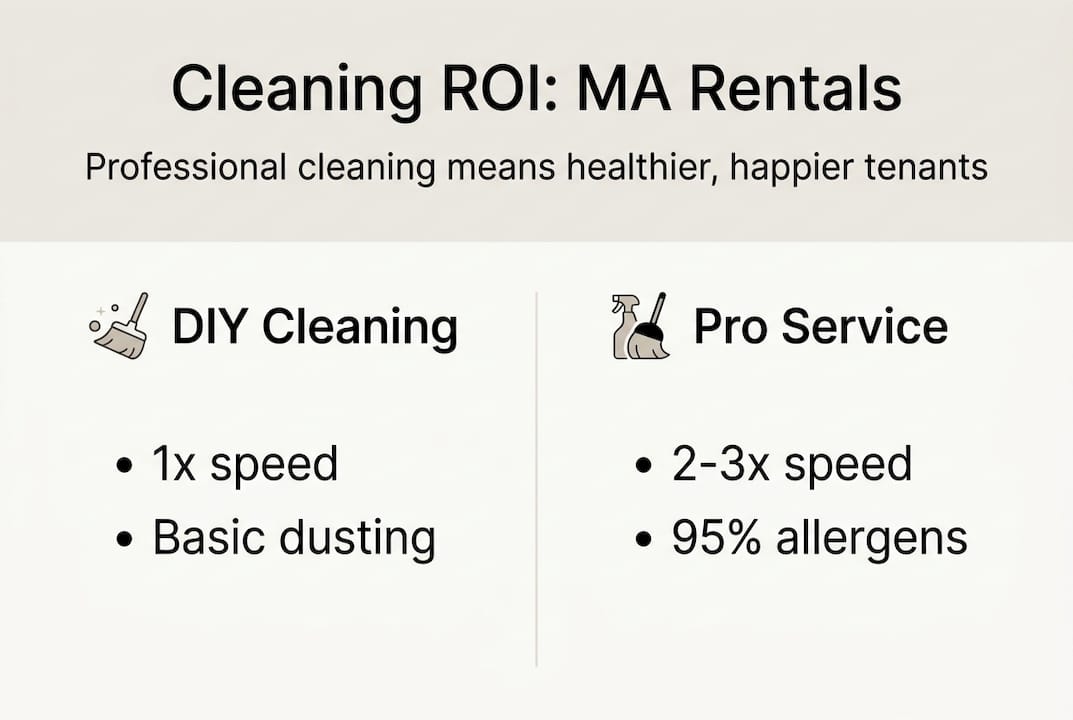
| Factor | DIY cleaning | Professional cleaning |
|---|---|---|
| Speed | 1x baseline | 2-3x faster |
| Allergen removal | Partial | Up to 95% removal |
| Liability coverage | None | Insured and bonded |
| Consistency | Variable | Standardized process |
| Equipment quality | Consumer grade | Commercial grade |
Pro Tip: Always request proof of insurance before hiring any cleaning team. If a cleaner is injured on your property or damages a fixture, an uninsured vendor leaves you exposed to liability claims that can far exceed the cost of the cleaning itself.
What does cleaning cost in Massachusetts?
Massachusetts cleaning rates run noticeably higher than the national average, and that gap is real. MA residential cleaning costs between $0.10 and $0.30 per square foot, while commercial properties run $0.12 to $0.28 per square foot. Both figures sit roughly 15 to 25% above national averages, driven by higher labor costs, insurance requirements, and the specialized products needed for local conditions.
Here’s what that looks like in real numbers:
| Property type | Size | Estimated cost range |
|---|---|---|
| Residential apartment | 800 sq ft | $80 to $240 |
| Single-family home | 1,800 sq ft | $180 to $540 |
| Small commercial office | 2,000 sq ft | $240 to $560 |
| Large commercial space | 5,000 sq ft | $600 to $1,400 |
Several factors push costs toward the higher end of those ranges:
- Turnover urgency — Rush turnovers between tenants cost more because teams must mobilize quickly
- Property condition — Heavy soiling, pet damage, or smoke odors require additional labor and product
- Eco-friendly products — Green-certified products carry a small premium but protect tenant health and surface finishes
- Insurance and bonding — Reputable vendors price this in, which is a feature, not a flaw
The professional cleaning cost breakdown shows that pros deliver real value beyond just speed. Removing up to 95% more allergens than DIY methods means fewer tenant health complaints and lower liability exposure for you as the property owner.
Pro Tip: Build two cleaning line items into your annual budget: one for turnover cleans after each tenancy and one for quarterly seasonal deep cleans. Treating these as fixed operating costs rather than reactive expenses makes forecasting far easier.
Seasonality and special cleaning considerations in Massachusetts
Massachusetts doesn’t give property managers a quiet season. Every quarter brings a distinct set of cleaning priorities, and missing the right timing means problems compound into the next season.
Quarterly deep cleaning is essential for managing the state’s seasonal challenges, from winter salt and mud to summer humidity allergens and coastal salt accumulation. Here’s what each season demands:
- Late winter/early spring — Deep clean entryways, hallways, and carpets after salt and mud season. Flush HVAC filters before allergen season begins
- Late spring/early summer — Address humidity-driven mold risk in bathrooms and basements. Clean windows inside and out after pollen season peaks
- Late summer — Sanitize high-use areas in vacation rentals and short-term properties after peak occupancy
- Fall — Clear gutters and outdoor entryways before leaf mold sets in. Service HVAC filters ahead of heating season
- Post-storm — Window cleaning and entryway sanitization after major nor’easters or coastal storms
For coastal properties, the stakes are higher. Salt air attacks window seals, corrodes HVAC components, and degrades outdoor entryway surfaces faster than inland properties. Scheduling more frequent exterior window cleaning and HVAC filter checks is not optional; it’s basic asset protection.
Short-term rental and Airbnb managers face a compressed version of these challenges. High turnover during summer and fall foliage season means you need a reliable cleaning partner who can turn units in tight windows without cutting corners. Using eco-friendly products for Massachusetts conditions keeps guest reviews strong and protects surfaces from the wear that comes with frequent cleaning cycles.
Pro Tip: Set a recurring calendar reminder every 90 days to schedule your next seasonal deep clean. Booking in advance secures your preferred time slots, especially during the busy spring and fall turnover seasons when cleaning teams fill up fast.
Review your MA seasonal cleaning checklist each quarter to make sure nothing slips through.
Our take: Why quality cleaning is the linchpin for happy tenants and hassle-free management
Here’s the uncomfortable truth most property management advice skips: cutting your cleaning budget is one of the most expensive decisions you can make. The math looks favorable on paper until you factor in the tenant who doesn’t renew because the unit felt neglected, the negative review that tanks your occupancy rate, or the surface damage that a thorough clean would have caught before it became a repair bill.
We’ve seen it repeatedly. Managers who invest in insured cleaners and consistent professional service spend less time managing complaints and more time growing their portfolios. Experienced cleaning teams also notice things a checklist won’t catch: early signs of water intrusion, pest activity, or HVAC issues that, if flagged early, cost a fraction of what they’d cost to fix later.
The real ROI of quality cleaning isn’t just a cleaner unit. It’s fewer vacancies, stronger reviews, lower maintenance costs, and a liability shield that protects you when something goes wrong. Treat cleaning as a core operational investment, not a line item to trim.
Take the next step: Reliable cleaning services for Massachusetts property managers
Managing properties in Massachusetts is demanding enough without worrying about whether your cleaning vendor will show up, do the job right, or leave you exposed to liability. E.C. House Cleaning brings over 20 years of local experience, eco-friendly products suited to Massachusetts conditions, and fully insured teams to every job.
Whether you manage a single rental unit or a portfolio of commercial spaces, we offer solutions built around your schedule and your tenants’ expectations. Explore what residential cleaning tasks look like when done to a professional standard, or find home cleaners in your area today. For office and retail spaces, our commercial cleaning guide walks you through exactly what to expect. Contact us for a free consultation and a personalized quote.
Frequently asked questions
How often should property managers schedule professional cleaning in Massachusetts?
Schedule professional deep cleaning at least quarterly for seasonal challenges including winter salt and mud, humidity allergens, and coastal salt, plus a full turnover clean every time a tenant moves out.
What cleaning services should be included during a tenant turnover?
Move-in ready standards include trash removal, deep cleaning of all surfaces, sanitizing kitchens and bathrooms, and a final walkthrough inspection to confirm the unit is ready for the next tenant.
Is it more cost-effective to hire professionals or do the cleaning in-house?
Professional teams are 2-3x faster and remove significantly more allergens than DIY methods, and their insurance coverage protects you from liability claims that in-house cleaning cannot address.
Are eco-friendly cleaning products necessary for Massachusetts properties?
Eco-friendly products are strongly recommended for Massachusetts properties to manage local allergens, protect surfaces in coastal environments, and meet the growing expectations of health-conscious tenants.
Recommended
- Massachusetts Cleaning Services – Professional Cleaning Service Boston
- Office cleaning best practices for Massachusetts 2026 | E.C. House Cleaning
- Professional cleaning before moving in: 2026 Massachusetts guide | E.C. House Cleaning
- Massachusetts deep cleaning checklist for homeowners 2026 | E.C. House Cleaning